AI Employee: What It Is, What It Costs, and Who Has to Run It (2026)
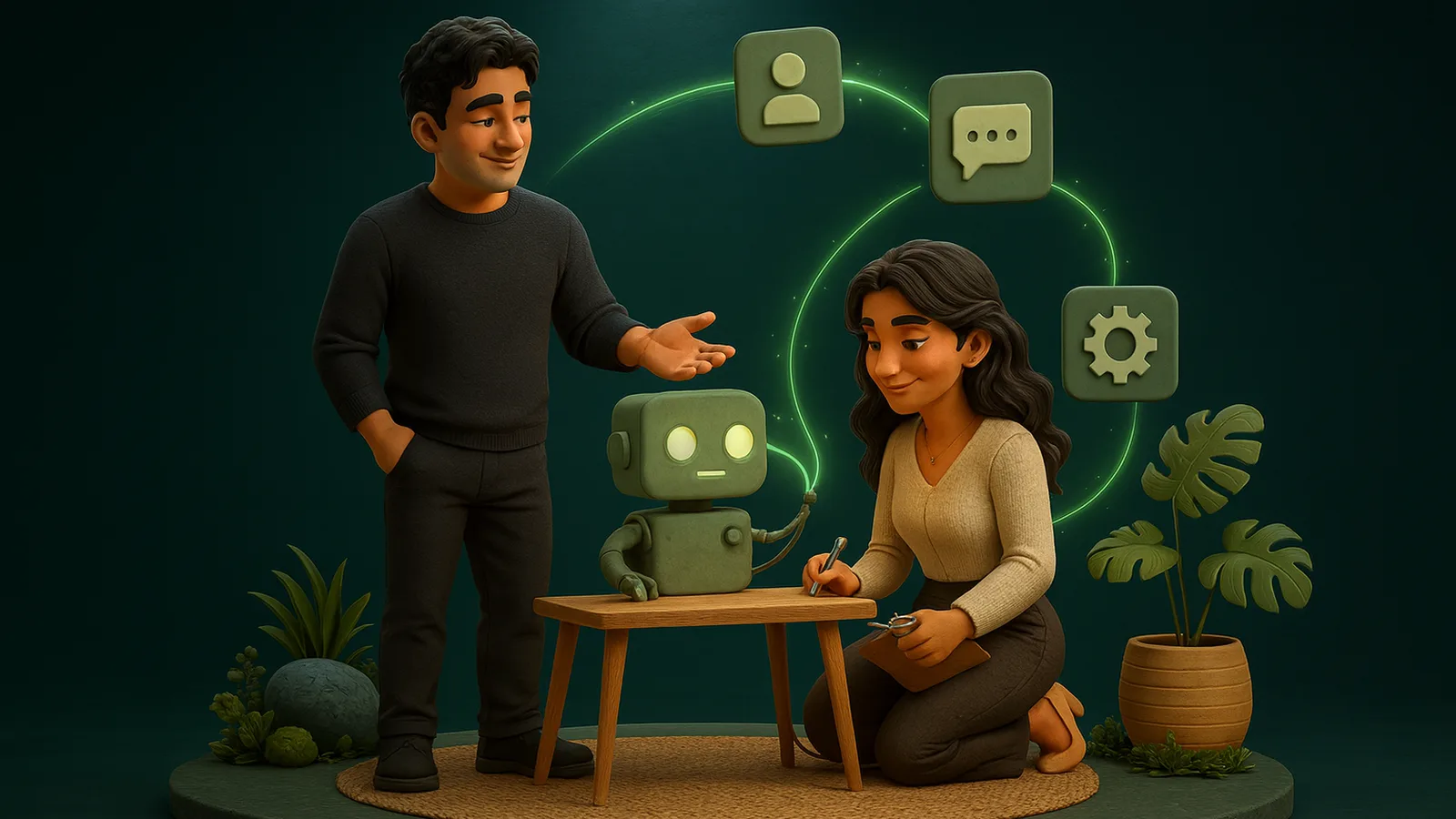
An AI employee is software that does the tasks of a role, like answering calls, following up leads or drafting support replies. It's a useful category of tool. But it isn't an employee: it doesn't decide what's worth doing, notice when it's wrong, or fix itself when your tools change. Someone still has to set it up, watch it and fix it. That person is your AI Operator.
AI employee software vs a person who runs AI
| AI employee software | AI Operator (a person) | |
|---|---|---|
| What it is | A product that performs one role's tasks | A full-time builder who runs AI across the business |
| Scope | One job: calls, leads, support, inbox | Every workflow worth automating |
| Decides what to automate | No | Yes |
| Notices when output is wrong | Only what it's built to check | Reads the outputs, catches the quiet failures |
| When your tools change | Waits for the vendor or for you | Fixes it the same day |
| How you pay | Per seat, per month or per use | A salary or a flat monthly fee |
| Best used | Under someone's supervision | Supervising the software |
Jump to: what the term means, what the software does, what it costs, or whether to hire one. For a list of what can be automated by job, see 25 AI agents for business.
"Hire an AI employee" is a great headline. It promises the outcome of a hire without the cost, the recruiting or the management.
I understand the appeal. I've built the software that sits behind that promise, with Claude Code, inside my own company. It works. It also needs a person, every week, or it quietly drifts. That's not a flaw in any one product. It's what software is.
So this guide takes the term seriously. What AI employee software is, what it really does well, what it can't do, what it costs, and the question the headline skips: who's going to run it?
01 · The Definition
What does "AI employee" mean?
"AI employee" is a marketing name for software that performs the recurring tasks of a job, such as a receptionist, a sales development rep or a support agent, using AI. It usually combines a language model, access to a few of your tools and a set of instructions. It does tasks; it doesn't own outcomes.
You'll also see it called an AI agent, an AI worker, a digital employee, an AI teammate or an AI assistant. They describe the same category: software that acts, rather than software that waits for you to click.
Here's the distinction that matters. A human employee owns an outcome: "leads get followed up". AI employee software performs a task: "send this follow-up". When the outcome needs something the task didn't anticipate, a lead who replies with a question, a form that changed, a customer who's angry, the software doesn't know it's failing. A person does.
02 · The Category
What can AI employee software actually do?
AI employee software does well-defined, repeating work: answering and routing calls, replying to new leads, drafting support answers from your documents, sorting an inbox, booking meetings and writing first drafts. It's strongest when the inputs are predictable and a person reviews the outputs.
The common categories, and where each tends to struggle:
| Category | What it does | Where it struggles |
|---|---|---|
| AI receptionist or voice agent | Answers calls, qualifies, books | Accents, angry callers, anything off-script |
| AI sales rep (SDR) | Researches prospects, drafts outreach, follows up | Your positioning; the reply that needs judgment |
| AI support agent | Answers from your help docs, hands off the rest | Questions your docs don't answer; refunds and exceptions |
| AI inbox assistant | Sorts mail, drafts replies | Your voice; what's urgent this week |
| AI content assistant | Drafts posts, emails, captions | Saying something only you would say |
| AI bookkeeping assistant | Categorizes transactions, chases invoices | Odd transactions; anything a tax adviser should see |
None of that is a reason not to use them. It's a reason to put a person over them.

03 · The Missing Piece
What can't an AI employee do?
An AI employee can't decide what your business should automate, can't tell when its own output is quietly wrong, can't fix itself when a connected tool changes, and can't be accountable for a result. Those four jobs are why every AI employee still needs a human owner.
Here's what that owner actually does:
- Sets it up. Maps the process, writes the instructions in your voice, connects the tools with the least access needed, and tests it against real cases before it touches a customer.
- Watches it. Reads the outputs every day. Not just the errors: the replies that ran fine and said the wrong thing.
- Fixes it. When your CRM renames a field, a price changes or customers start asking a new question, they update it the same day.
- Decides what's next. Which task to automate after this one, and which to stop.
The Federal Reserve's latest small business survey shows how far most companies are from that. 46% of small employer firms use AI. Of those, 83% use it for writing or marketing, but only 7% say they've fully integrated AI into their business; about half are still experimenting and 44% have partly integrated it (Federal Reserve Banks, 2026 Report on Employer Firms).
Source: Federal Reserve Banks, 2026 Report on Employer Firms (Small Business Credit Survey), 2025 survey data. The 83% and 7% are shares of firms that use AI.
That gap between "using" and "integrated" isn't a software gap. The software exists. It's an ownership gap: nobody whose job it is.
An AI employee is software. Someone still has to set it up, watch it and fix it.
04 · The Price
How much is an AI employee?
AI employee software is usually priced per seat, per month or per use, and the general-purpose tools behind most of it start around $20 to $25 a user a month. The full cost includes the person who runs it. A Pareto AI Operator is $3,600 a month; a US software developer earns a median $135,980 a year.
The software side, from vendor pricing pages checked on 2026-10-16:
| Tool | Price | Source |
|---|---|---|
| Claude Team, standard seat | $25 a month, or $20 billed annually (2-seat minimum) | Claude pricing |
| ChatGPT Business, standard seat | $25 a month, or $20 billed annually (2-seat minimum) | OpenAI Help Center |
| Zapier Agents | 400 activities a month on Free, 1,500 on Professional | Zapier pricing |
| n8n Cloud Starter, with agents and AI nodes | $20 a month billed annually, $24 monthly | n8n pricing |
The person side is the bigger number, whoever it is. For scale: a US software developer earns a median $135,980 a year before benefits (BLS OEWS, May 2025), and you meet 3 certified AI Operator profiles within 24 hours of a call instead of running a search. A Pareto AI Operator is $3,600/month, month to month, plus a one-time $3,000 placement fee. It's paid once, on your call, and comes back in full if none of your 3 profiles fit. Our AI operator cost guide prices every other option on the same basis.
Put a person over your AI
Meet 3 certified AI Operators within 24 hours of a short call. They set up your AI tools, watch every run and fix what breaks, full-time, in your Slack.
05 · Small Business
Should a small business hire an AI employee?
A small business should buy AI employee software for one narrow, repeating job with predictable inputs, and only if someone will review its work every day. If you want AI across several jobs, or nobody has time to supervise it, hire the person first. Then let them choose the software.
Three situations, three answers:
- One clear job, and you have an owner. Buy the software. A receptionist tool for a clinic that misses calls is a good example. Name the person who reviews its calls every morning.
- Several jobs, no owner. Don't buy five AI employees. Hire one person who can build or buy what each job needs and run all of it. That's the role we call an AI Operator.
- You're not sure what to automate. Start with an assessment, not a purchase. Our AI readiness assessment scores where AI would save you time, and an AI consultant can turn that into a plan.
Questions to ask before you "hire" AI employee software
- Whose account does it run in, and can I export everything if I leave?
- Can I see a log of every action it took?
- Can I make it draft instead of send, and approve before anything goes out?
- Does the vendor train its models on my data?
- When it's wrong, how do I find out, and who fixes it?
If the answer to the last one is "you", you've found the hidden job description. Our AI automation specialist job description is that role, written out.
06 · The Reframe
What's the difference between an AI employee and an AI Operator?
An AI employee is software that performs one role's tasks. An AI Operator is a person who builds, runs and fixes the AI across your business, including any AI employee software you buy. One is a tool; the other owns the tools.
At Pareto Talent, every AI Operator we certify finishes 40+ hours of training, then a 5-day final project where they build a full funnel with AI, scored on a 25-point rubric, plus an interview. They work full-time on your hours, inside your Slack and your tools. Every account stays in your name, every automation is watched (we call it Run Watch), and every Friday you get a note: what shipped and what's next.
If you're weighing an agency instead, read AI automation agency vs AI operator and our guide to AI automation agencies. If you need software built as a product, hire an AI developer.
More in this series: 25 AI agents for business, n8n vs Zapier vs Make, Claude for business, AI automation specialist job description, best AI tools for small business, fractional chief AI officer. Hiring instead? See hire an AI developer or hire an n8n expert.
FAQ
Frequently asked questions
What does "AI employee" mean?
What is an AI employee called?
How much is an AI employee?
Can I get an AI assistant for free?
Can AI replace an employee?
Is it safe to give AI employee software access to my business?
Do AI employees work for small businesses?
Sources
Sources
- Federal Reserve Banks, "2026 Report on Employer Firms" (Small Business Credit Survey, 2025 data), checked 2026-10-16: 46% of small employer firms use AI; of AI users, 83% use it for writing or marketing, 7% have fully integrated it, about half are experimenting and 44% have partly integrated it.
- Claude, Pricing, checked 2026-10-16.
- OpenAI Help Center, "Managing billing and seats in ChatGPT Business", checked 2026-10-16.
- Zapier, Pricing, checked 2026-10-16: agent activities by plan.
- n8n, Pricing, checked 2026-10-16.
- U.S. Bureau of Labor Statistics, Occupational Employment and Wages, Software Developers (15-1252), May 2025: median $135,980 a year.
- Anthropic, "Claude for Small Business", May 13, 2026: no training on data by default on Team and Enterprise plans.
Written by Ivan Bunin from his own experience building and running AI tools at Pareto Talent. Reviewed and updated quarterly.

Someone still has to run it
Meet 3 certified AI Operators within 24 hours of a short call and choose yours. They set up your AI, watch it every day and fix it when it breaks. $3,600/month, month to month, plus a one-time $3,000 placement fee. It's paid once, on your call, and comes back in full if none of your 3 profiles fit.
100+ founders served · 3 certified profiles in 24 hours · Month to month