Real Estate Business Plan Template for Team Leaders (2027)

A real estate business plan fits on two pages: last year's numbers, who you serve and why you, next year's goal worked backwards into weekly activity, where the business comes from, the team, marketing, systems, budget, what you stop doing yourself, and a quarterly calendar. Copy the template below, fill it in one sitting, and review it every quarter. The section most plans skip is the one that decides whether yours survives February: if the goal needs more of your hours than you have, the plan has to say who does the rest.
This template is for agents who sell, lead a team and run the back office at the same time. It has ten sections. Nine are the standard parts of a plan, from last year's numbers to the budget. The other one, what you stop doing in 2027, is the one most templates leave out, and the one that usually breaks the plan. Solo agent? The one-page version is here.
How to use it:
- Block 90 minutes and pull last year's numbers from your CRM and your transaction tool before you start.
- Fill it in order. Each section feeds the next: the goal sets the activity, the activity sets the team, the team sets the budget.
- Share it with your team and put the four quarterly reviews on the calendar the day you finish.
- Download it for Word, Google Docs or Excel below, or copy the text.
The Template
The 2027 real estate business plan template
Copy it into a doc, a note or your CRM. Every [ ] is a blank to fill.
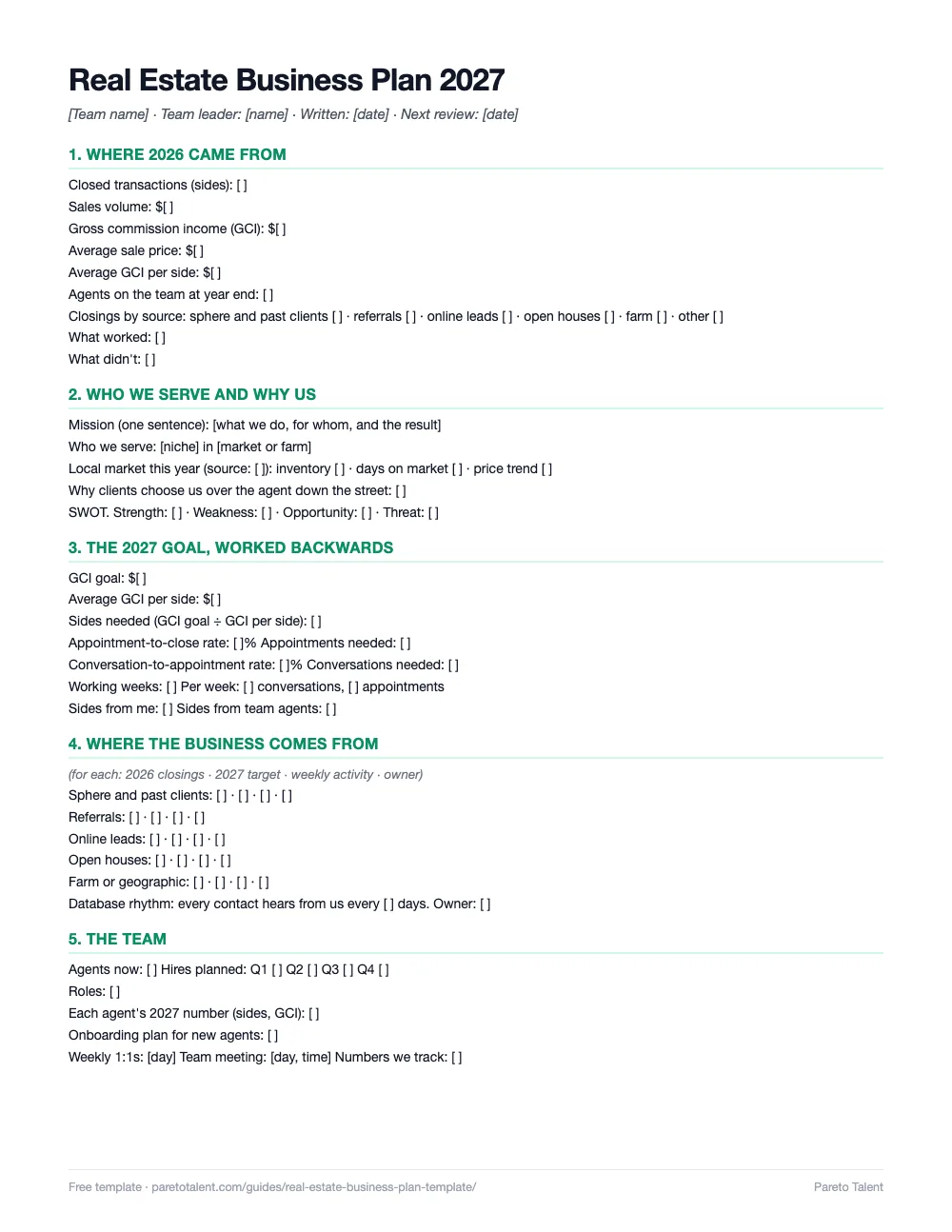
REAL ESTATE BUSINESS PLAN: 2027
[Team name] · Team leader: [name] · Written: [date] · Next review: [date]


1. WHERE 2026 CAME FROM
Closed transactions (sides): [ ]
Sales volume: $[ ]
Gross commission income (GCI): $[ ]
Average sale price: $[ ]
Average GCI per side: $[ ]
Agents on the team at year end: [ ]
Closings by source: sphere and past clients [ ] · referrals [ ] · online leads [ ] · open houses [ ] · farm [ ] · other [ ]
What worked: [ ]
What didn't: [ ]


2. WHO WE SERVE AND WHY US
Mission (one sentence): [what we do, for whom, and the result]
Who we serve: [niche] in [market or farm]
Local market this year (source: [ ]): inventory [ ] · days on market [ ] · price trend [ ]
Why clients choose us over the agent down the street: [ ]
SWOT. Strength: [ ] · Weakness: [ ] · Opportunity: [ ] · Threat: [ ]


3. THE 2027 GOAL, WORKED BACKWARDS
GCI goal: $[ ]
Average GCI per side: $[ ]
Sides needed (GCI goal ÷ GCI per side): [ ]
Appointment-to-close rate: [ ]%   Appointments needed: [ ]
Conversation-to-appointment rate: [ ]%   Conversations needed: [ ]
Working weeks: [ ]   Per week: [ ] conversations, [ ] appointments
Sides from me: [ ]   Sides from team agents: [ ]


4. WHERE THE BUSINESS COMES FROM
(for each: 2026 closings · 2027 target · weekly activity · owner)
Sphere and past clients: [ ] · [ ] · [ ] · [ ]
Referrals: [ ] · [ ] · [ ] · [ ]
Online leads: [ ] · [ ] · [ ] · [ ]
Open houses: [ ] · [ ] · [ ] · [ ]
Farm or geographic: [ ] · [ ] · [ ] · [ ]
Database rhythm: every contact hears from us every [ ] days. Owner: [ ]


5. THE TEAM
Agents now: [ ]   Hires planned: Q1 [ ] Q2 [ ] Q3 [ ] Q4 [ ]
Roles: [ ]
Each agent's 2027 number (sides, GCI): [ ]
Onboarding plan for new agents: [ ]
Weekly 1:1s: [day]   Team meeting: [day, time]   Numbers we track: [ ]


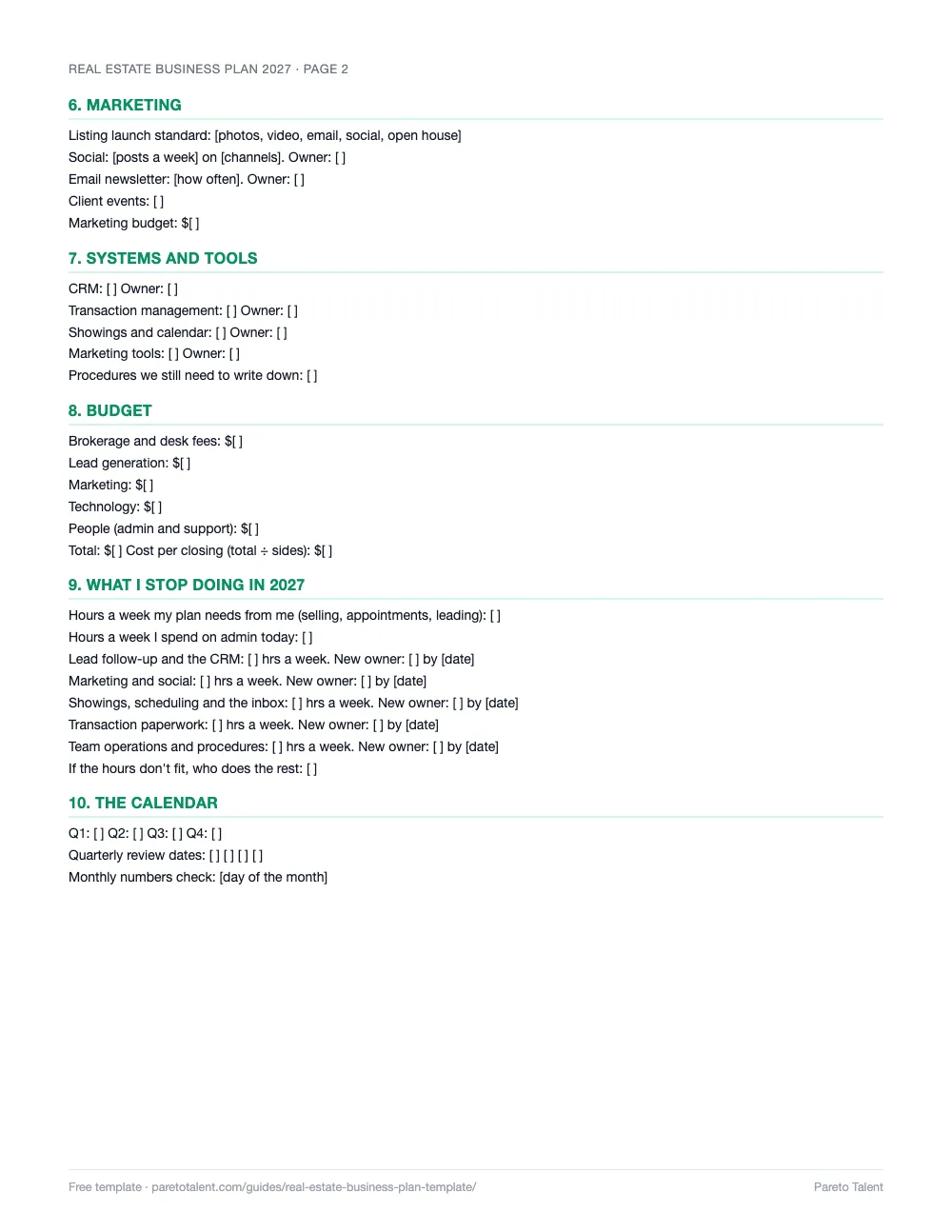
6. MARKETING
Listing launch standard: [photos, video, email, social, open house]
Social: [posts a week] on [channels]. Owner: [ ]
Email newsletter: [how often]. Owner: [ ]
Client events: [ ]
Marketing budget: $[ ]


7. SYSTEMS AND TOOLS
CRM: [ ]   Owner: [ ]
Transaction management: [ ]   Owner: [ ]
Showings and calendar: [ ]   Owner: [ ]
Marketing tools: [ ]   Owner: [ ]
Procedures we still need to write down: [ ]


8. BUDGET
Brokerage and desk fees: $[ ]
Lead generation: $[ ]
Marketing: $[ ]
Technology: $[ ]
People (admin and support): $[ ]
Total: $[ ]   Cost per closing (total ÷ sides): $[ ]


9. WHAT I STOP DOING IN 2027
Hours a week my plan needs from me (selling, appointments, leading): [ ]
Hours a week I spend on admin today: [ ]
Lead follow-up and the CRM: [ ] hrs a week. New owner: [ ] by [date]
Marketing and social: [ ] hrs a week. New owner: [ ] by [date]
Showings, scheduling and the inbox: [ ] hrs a week. New owner: [ ] by [date]
Transaction paperwork: [ ] hrs a week. New owner: [ ] by [date]
Team operations and procedures: [ ] hrs a week. New owner: [ ] by [date]
If the hours don't fit, who does the rest: [ ]


10. THE CALENDAR
Q1: [ ]   Q2: [ ]   Q3: [ ]   Q4: [ ]
Quarterly review dates: [ ] [ ] [ ] [ ]
Monthly numbers check: [day of the month]
Free, no email needed. The Word file is the template above. The spreadsheet has the goal calculator, lead sources, budget and a weekly time budget, with the formulas built in.
01 · The Review
Where did 2026 actually come from?
Start with what happened, not what you hoped. Pull every closing from last year and tag it by source: sphere and past clients, referrals, online leads, open houses, your farm. Most team leaders are surprised by one number here, usually how much came from people who already knew them.
Write down two things in plain words: what worked, and what didn't. "We stopped calling past clients in the summer" is more useful than "lead generation was down."
02 · The Position
Who do you serve, and why you?
Three lines and a grid. Skip them and the marketing section turns into a list of tactics with no target.
- Your mission, in one sentence. What you do, for whom, and the result. "We help first-time buyers in [your area] buy without overpaying" is a mission. "Excellent service" isn't.
- Who you serve, and where. Your niche (first-time buyers, relocation, luxury, one neighborhood) and your farm or market. Add three local numbers for this year from a source you can name, such as your MLS's market report: inventory, days on market and the price trend.
- Why you. The one thing clients say you do better than the agent down the street. If you're not sure, ask your last ten clients.
Then a SWOT in four lines: one strength, one weakness, one opportunity and one threat. Be specific. "Follow-up depends on me" is a weakness you can fix in section 9. "Great market knowledge" is too vague to act on.
03 · The Goal
How many deals does your 2027 goal take?
Work backwards from income to weekly activity. The math is four divisions:
- Sides needed = GCI goal ÷ average GCI per side.
- Appointments needed = sides ÷ your appointment-to-close rate.
- Conversations needed = appointments ÷ your conversation-to-appointment rate.
- Per week = each number ÷ the weeks you'll actually work.
Use your own rates from section 1, not someone else's. If you don't track them yet, that's the first system for 2027.
Goal calculator (the inputs below are examples; replace each with your own numbers)
The last line of that calculator is the real question. A goal that needs 20 conversations a week is a plan for someone's calendar. Section 9 decides whose.
04 · The Database
Where will the business come from?
List every source, last year's closings from it, this year's target, the weekly activity that produces it, and one owner. "The team" is not an owner.
- Sphere and past clients. Your past clients are your next listings. Decide how often every contact hears from you, and who sends it.
- Referrals. Who sent you business last year, and how will you thank them this year?
- Online leads. Set a response-time standard and a follow-up rhythm for the leads who aren't ready yet.
- Open houses and your farm. Plan them by the month, with the follow-up written before the event.
A database plan works only if someone runs the rhythm every week. That's why the owner column matters more than the target column.
05 · The Team
Who sells, and who supports?
Write each agent's 2027 number next to their name, then plan the hires by quarter. For every new agent, decide the onboarding plan before they start: who trains them, what they shadow, when they take their first lead.
Then the rhythm that keeps it honest: a weekly 1:1 with each agent, one team meeting with an agenda sent the day before, and the few numbers everyone sees. If the agenda, the 1:1 notes and the numbers all depend on you, put that on the list in section 9.
06 · Marketing
What goes out every week?
Set a standard for every listing launch (photos, video, the email to your sphere, social posts, the open house) so nobody reinvents it. Then commit to a cadence you'll keep: posts a week, a monthly newsletter, two or three client events a year. Name an owner for each, and a budget.
07 · Systems
Which tools run the business, and who owns each?
List your CRM, your transaction tool, your showing and calendar setup and your marketing tools, with one owner each. Then list the procedures that still live in your head. Those are the first things to write down, because nobody can take over a process you can't describe.
08 · Budget
What does it cost to run?
Add up brokerage and desk fees, lead generation, marketing, technology and people. Divide the total by your sides to get your cost per closing, and watch that number each quarter. Count your own admin time as a cost, too: an hour you spend on paperwork is an hour you didn't spend on an appointment.
09 · Delegation
What will you stop doing in 2027?
This is the section that decides whether the plan survives. Two numbers:
- Hours a week your plan needs from you: appointments, listing presentations, negotiating, leading the team.
- Hours a week you spend on admin today: follow-up, posts, scheduling, paperwork, team logistics.
If the two add up to more hours than you have, the plan doesn't work as written. Something has to move. These are the five jobs agents and team leaders hand off first:
| The job | What handing it off looks like |
|---|---|
| Lead follow-up and the CRM | New leads answered the same day; past clients and your sphere on a rhythm; notes and tasks current in Follow Up Boss or your CRM |
| Marketing and social | Listing launches, weekly posts, Canva graphics and the newsletter go out without you writing them |
| Showings, scheduling and the inbox | Showing requests confirmed, your calendar protected, your inbox sorted with replies drafted for your yes |
| Transaction paperwork | The contract-to-close checklist, dates, lender and title emails and client updates, with you pulled in only when a file needs you |
| Team operations | The recruiting pipeline, new-agent onboarding, meeting agendas and the procedures your team works from |
Anything your state requires a license for stays with you and your licensed agents (here's where that line sits). The rest is admin, and admin can move.
Block your week before you fill it
Time management for a real estate agent comes down to one rule: the hours that make money go on the calendar first, and everything else fits around them. Here's an example week for a team leader. Change the times; keep the order.
| Block | When | Owner |
|---|---|---|
| Lead conversations and follow-up calls | Every morning, before appointments | You and your agents |
| Appointments, listing presentations and negotiations | Afternoons | You |
| 1:1s and the team meeting | Monday morning | You |
| Follow-up texts and emails, the CRM, posts, the inbox, showing confirmations and files | All day | Your Right Hand |
| Plan review: this week's numbers against the plan | Friday, 30 minutes | You, with the report your Right Hand prepared |
Two signs it's time to move it: you're the marketing person, the salesperson and the team lead at once, or your last assistant left and the work came back to you. Not sure where your hours go? Run a time audit for one week first, then fill in this section with real numbers. For a sorting system, see what to delegate first.
If the answer is one person, full-time
A Right Hand is a full-time executive assistant from Latin America who takes all five of those jobs for one team, trained on AI before you meet them. You meet 3 hand-picked candidates within 24 hours of your Matching Call.
10 · The Calendar
When will you check it?
Put one milestone in each quarter and the four review dates on the calendar now. Check the numbers monthly: sides, appointments, conversations and cost per closing. Review the whole plan each quarter, and change the goal only when the market or the team changes, not because one month was slow.
Adapt It
Solo agent, team or brokerage: what changes?
The ten sections work at every size. What changes is whose numbers they are.
| Section | Solo agent | Team leader | Brokerage owner |
|---|---|---|---|
| 3 · The goal | Your own GCI | The team's GCI, split by agent | Company revenue and agent count |
| 5 · The team | Who supports you | Agents, hires, onboarding, 1:1s | Recruiting, retention and managers |
| 8 · Budget | Your costs, your admin hours included | Team costs and splits | Office, staff and the technology agents use |
| 9 · Delegation | Your first hire | Who owns the team's admin | Who supports the agents, and who supports you |
For a solo agent, one page is enough: sections 1, 3, 4 and 9.
Pitfalls
Five ways a plan breaks by February
- The goal has no activity math. A GCI number with no weekly conversations behind it is a wish. Section 3 turns it into a week.
- The activity has no owner. "The team will follow up" means nobody will. Every line in section 4 gets a name.
- The plan needs more hours than you have. That's what section 9 is for. Find the gap in January, not in March.
- Nobody looks at it until December. Put the four review dates on the calendar the day you finish.
- Marketing is a list of ideas, not a cadence. "Post more" isn't a plan. "Three posts a week, owner: [name]" is.
FAQ
Frequently asked questions
What should a real estate business plan include?
How do I write a business plan for a real estate team?
How many deals do I need to hit my GCI goal?
When should a real estate agent hire an assistant?
What should a real estate agent delegate first?
How often should I review my real estate business plan?
What are the 7 parts of a business plan?
Can a real estate business plan fit on one page?
Can ChatGPT write a real estate business plan?
What is the 80/20 rule for Realtors?
How many deals does it take to make $100,000 in real estate?
Sources: U.S. Small Business Administration, Write your business plan, checked November 18, 2026.
Written by Ivan Bunin. Pareto Talent places full-time Right Hands with founders, real estate agents and team leaders. This template is ours to share: copy it, change it, use it with your team. It contains no industry benchmarks; the calculator's starting values are examples, not averages.

Your plan needs more hours than you have. Put a Right Hand in it.
A Right Hand is a full-time executive assistant from Latin America who takes the follow-up, the marketing, the showings, the files and the team admin, trained on AI before you meet them. $36,000 a year on the annual plan, $10,000 a quarter or $3,600 a month, plus a one-time $3,000 placement fee.
The Matching Guarantee: meet 3 hand-picked candidates within 24 hours of your Matching Call and choose. Your monthly plan starts when you pick your Right Hand.
Lifetime Replacement: if it ever stops being a fit, we replace your Right Hand at no cost, for as long as you're with us.
100+ founders served · 1 in 1,000 applicants makes it through · 40+ hours of training